Aventon Aventure 3 review
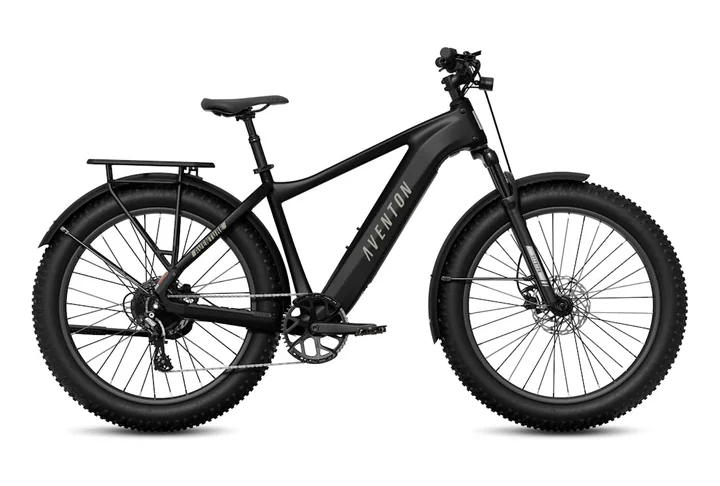
A powerful, well-built fat-tire ebike with a torque sensor and a polished app. The Aventure 3 handles trails, sand and snow while staying planted on pavement.
Check price at Aventon →- Strong 1,440W peak power
- Torque sensor feels natural
- 4-inch fat tires for any terrain
- Polished app and color display
- Hydraulic brakes and turn signals
- Heavy, around 77 lbs
- Fat tires drag on pavement
- Pricier than budget fat-tire rivals
- Bulky to store
One number ends up deciding whether you should buy the Aventon Aventure 3: 77 pounds. I've put real miles on this fat-tire bike (commuting on pavement, messing around on hardpack trail, and crawling through one genuinely miserable stretch of soft beach sand), and the verdict is easy. This is the fat-tire bike I actually recommend to people who want a fat-tire bike. The torque sensor and the 1,440W peak make it feel lively in a way most bikes in this category don't. But it is a tank, and that weight is the whole story of who it fits.
At $1,749 it isn't the cheapest fat tire you can buy, and it isn't trying to be. What you're paying for is a bike that rides like Aventon engineered it on purpose, not one that just slapped big tires on a budget frame and called it adventure-ready. I rode it for weeks before writing a word; here is how we test.
How the Aventon Aventure 3 actually rides
The thing you feel in the first 30 feet is the torque sensor. It reads how hard you're actually pushing and meters the motor to match, instead of the on-off jolt you get from the cadence sensors that rule the budget tier (the difference is bigger than it sounds, and I unpack it in hub motor vs mid-drive). You lean into the pedals, the bike leans in with you. Ease off, it eases off. It's the difference between riding a bike and riding a scooter that happens to have pedals.
That 750W motor with a 1,440W peak gives it real shove. On flat pavement it gets to its 28 mph top assist (it ships as Class 2 and you unlock Class 3 in the app) without drama, and it holds that speed instead of sagging. The peak wattage is where the fun lives though. Hit a steep driveway or a short punchy climb and the bike just digs in. I never had to drop to the granny strategy of standing on the pedals and praying. It pulls.
On trail and hardpack the 4-inch fat tires do their job: they float over roots, gravel and the kind of washboard dirt road that rattles a commuter bike's fillings loose. Drop the pressure a few psi and the grip gets even better. Sand is the honest test, and most reviews skip the part where fat tires help in sand but don't make it easy. On firm wet sand near the waterline the Aventure 3 was great. On dry, loose, deep stuff it bogged like everything else does, and that's when you remember you're muscling 77 lbs around. Fat tires are a real advantage on loose terrain, just don't expect magic.
Real-world range versus the 65 mile claim
Aventon advertises up to 65 miles, and I want to be straight with you about that figure: it's the perfect-conditions ceiling, so shave a good chunk off it for the riding you'll actually do (here is why that gap exists). On the Aventure 3, with its roughly 720Wh battery, that plays out about how you'd expect. Riding it the way most people will (assist level 3 or 4, real hills, my actual body weight, plenty of starting and stopping at lights) I landed in the 30 to 45 mile range. Crank it to full assist and ride aggressively in the cold and you'll see the low end of that fast. Babysit it on level 1 on a flat bike path and you might brush 55. Plan your commute around the middle of that range, not the 65.
One thing the fat tires cost you: rolling resistance. Those big 4-inch tires are heavier and grippier, which is great for terrain and bad for efficiency. A lighter commuter on skinny tires with the same battery would go noticeably farther. That's the trade you're signing up for.
The 77 pound reality nobody warns you about
Let's talk about the weight, because it's the single biggest reason to buy this bike or walk away from it. At about 77 lbs, the Aventure 3 is one of the heaviest bikes on this list. On the road you barely notice it; the motor is moving the mass, not you. Off the road is where it bites.
If you live in a third-floor walkup, this bike is not happening. If you need to lift it onto a standard hitch bike rack, you'll need a rack rated for heavy ebikes and probably a second set of hands. If your battery dies five miles from home, you're not really pedaling 77 lbs of dead bike back, you're shoving it. And if you ever drop it in soft sand or a ditch, picking it back up is a full-body event.
None of this is a defect. It's just physics: fat tires, a big battery and a sturdy frame add up. But it means the Aventure 3 belongs to people who can roll it out of a garage and ride, not people who have to carry it. If carrying or lifting is part of your daily reality, you are genuinely better off on a lighter bike, and I'll point you to the right one below.
App, color display, turn signals and the daily details
This is where Aventon's polish shows up and where the cheaper fat tires fall behind. The color display is bright and readable in direct sun, which matters more than it sounds when you're squinting at speed and battery at noon. The app is genuinely good: you unlock Class 3, tweak assist behavior, see ride stats and run diagnostics, and it actually pairs reliably instead of dropping connection every other ride.
The integrated turn signals are the feature I didn't expect to care about and now miss on other bikes. On a heavy bike at 28 mph in traffic, being able to signal without taking a hand off the bar is a real safety win, not a gimmick. The lights are bright enough to be seen by, not just to be legal.
Build-wise, this is a solid bike. The frame feels planted, nothing creaks, and the components are a step up from budget fat tires. Aventon's support and parts availability are good in the US, which matters because eventually something on every bike needs service. Two ownership tips from experience: keep those fat tires properly inflated (they look fine when they're actually 5 psi low, which wrecks your range and handling), and store the battery indoors in winter. Cold batteries lose range and a frozen one wears out faster. The battery itself is a quality unit, but no battery loves a freezing garage.
Aventon Aventure 3 versus the cheaper fat-tire rivals
The Aventure 3's real competition isn't the premium commuters, it's the wave of cheaper fat tires, and the headline one is the Lectric XP4. The XP4 starts at $999, folds, and on paper looks like a steal: up to an 840Wh battery and a big advertised range. So why pay $750 more for the Aventon?
Two words: torque sensor. The XP4 uses a cadence sensor, and as I covered up top, that's a real difference in how the bike feels under you. The Lectric is a tremendous value and the right call if budget is the deciding factor or you need it to fold, but it rides like a value bike. The Aventure 3 rides like a refined one. If budget and folding are your priorities, read my full take on the lighter, foldable Lectric XP4 before you commit. You're also getting the better display, the more polished app and the integrated turn signals.
| Spec | Aventon Aventure 3 | Lectric XP4 |
|---|---|---|
| Price | $1,749 | From $999 |
| Sensor | Torque (natural feel) | Cadence |
| Motor | 750W, 1,440W peak | 500W (750W option) |
| Battery | ~720Wh | Up to 840Wh |
| Top speed | 28 mph (Class 3 unlock) | 28 mph (Class 1/2/3) |
| Weight | ~77 lbs | 62 lbs |
| Folds | No | Yes |
If you want the full breakdown of that matchup, I wrote it up in Aventon vs Lectric. And if you've decided fat tires are your thing, the best fat-tire electric bikes roundup puts the whole field side by side. You can check the current Aventure 3 price if you're leaning this way.
Who should buy it and who should skip it
Buy the Aventon Aventure 3 if you want a do-everything bike that feels great to ride, you'll mix pavement with dirt, gravel or beach, and you can store it at ground level and roll it out the door. If you're upgrading from a cadence-sensor bike, the torque sensor alone will make you grin. It's a genuinely good bike, not a compromise, and for the right rider it's worth every dollar over the budget options. The polish (app, display, signals) makes it a pleasure to live with day to day.
Skip it if any of these are you: you have to carry the bike up stairs or lift it onto a rack regularly (the 77 lbs will wear you down), your riding is purely smooth-pavement commuting (you're paying a weight and range penalty for fat tires you don't need, and a lighter commuter like the Velotric Discover 2 will serve you better), or you mainly want to haul kids and groceries (look at a proper cargo bike instead).
Not sure whether a fat tire is even the right shape for your life? Start with how to buy an electric bike and hub motor vs mid-drive before you spend. And if you want to confirm what Class 3 actually means for where you can legally ride, ebike classes explained covers it. When you're ready, you can see the Aventure 3 at Aventon.
Check current pricing and color options direct from Aventon. They ship nationwide and run regular sales.
Affiliate link. We may earn a commission at no extra cost to you. It never changes our rankings (see how we test). We ride every bike before we recommend it.
Frequently asked questions
Is the Aventon Aventure 3 worth the extra money over a cheaper fat-tire bike?
For most riders, yes. The torque sensor makes it feel far more natural than the cadence-sensor bikes that dominate the budget tier, and the app, color display and turn signals are genuinely better. If budget is your hard limit or you need it to fold, a cheaper bike like the Lectric XP4 makes sense. Otherwise the Aventure 3 earns its price.
What is the real-world range of the Aventon Aventure 3?
Aventon advertises up to 65 miles, but treat that as the perfect-conditions ceiling rather than a planning number. In normal riding with real hills and stop-and-go traffic, expect roughly 30 to 45 miles from the 720Wh battery. Baby it on low assist on flat ground and you might approach 55. Plan your commute around the middle, not the top.
Is 77 pounds too heavy for an everyday electric bike?
It depends entirely on your situation. On the road you won't feel the weight because the motor does the work. The problem is off the bike: lifting it onto a car rack, carrying it up stairs, or pushing it home if the battery dies. If you can store it at ground level and just roll out, the weight is a non-issue. If you have to carry it, choose a lighter bike.
Can the Aventon Aventure 3 go 28 mph?
Yes, but you have to unlock it. The bike ships as a Class 2 (20 mph throttle, 20 mph assist) for legal reasons, and you raise it to Class 3 with up to 28 mph pedal assist in the Aventon app. Check your local rules first, since some bike paths and trails restrict Class 3 bikes to roads only.
How does the Aventon Aventure 3 handle sand and trails?
On trails, gravel and hardpack it's excellent. The 4-inch fat tires float over rough surfaces, and dropping a few psi adds grip. Sand is more honest: fat tires help on firm or wet sand but still bog down in deep, dry, loose stuff, where the bike's weight works against you. It's far better off-road than a commuter bike, just not unstoppable in the worst conditions.

I wrench on and ride these bikes year round, and I write every review and guide here. I rank by what holds up on real roads, not by who pays the most. How we test →